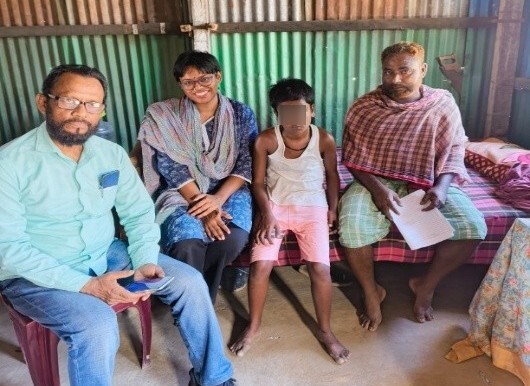
W is an experienced Field staff member in our Goalpara Community program. He first heard Irfan Ali's name at Rahmadpur LP School, Goalpara where Irfan's mother had come looking for him. She had heard he could help. That conversation led W to her doorstep.
Nobody in the family could say exactly how old Irfan was. His mother gave one age, his father another, and Irfan himself a third. Somewhere in that confusion was a boy of around eleven or thirteen, blind since the age of four. He hadn't always been this way, his sight had been fine until a high fever came on, and an unprescribed medicine, taken in desperation, took his vision with it.
As W talked with the family, a bigger problem surfaced. Irfan was born at home, so he had no birth certificate — and without one, none of the other documents he needed, not an Aadhaar card, not a UDID card, could even be applied for. It was the first domino, and it hadn't fallen yet.
To get a birth certificate this late, the rules required a certificate from a school first. So, W went to the Headmaster of Rahmadpur LP School and made his case to enrol Irfan, issue the certificate, and set in motion everything that followed. Luckily, the Headmaster agreed, and W was able to applu for the birth certificate, secure the necessary clearance from the DC's office, and a month later, it arrived.
Next came the Aadhaar card. Since only Irfan's mother had one, his was linked to hers through the biometric process — another month's wait, another small victory. Now, with both the birth certificate and Aadhaar in place, W could finally apply for what the family had needed most: Irfan's UDID card.
This is where the process tested everyone's patience. W stayed on it, following up repeatedly with the Joint Director Health, office. A medical camp that was supposed to assess Irfan kept getting postponed — no doctor available, day after day — until it finally happened. Even then, when the card didn't arrive, the family assumed it simply wasn't coming. W asked them not to give up; he had them check the online portal with their registration number, and lo and behold, there it was! — updated on the 20th of June. They got it printed and laminated. Irfan's disability was certified at 80%.
.png)
Relieved but unsure of what came next, the family turned to W again. He told them this wasn't the end — on his next visit, he would sit with them and walk through everything the UDID card now made possible: the benefits, the access, the doors it could open. He began connecting Irfan to Rashtriya Bal Swasthya Karyakram (RBSK) officials, and other service providers working in the area, so the support wouldn't stop with one card.
Told like this, in hindsight, it can sound straightforward — a certificate here, an application there. But behind every document was a months-long battle with the system, repeated visits to follow up with officials, and a family that didn't always have the energy or trust to keep going. It was W's persistence, more than the paperwork, that finally got Irfan what he needed.